Log Home Construction in Ontario: A High-Performance Thermal Envelope That Acts Like a Thermal Battery
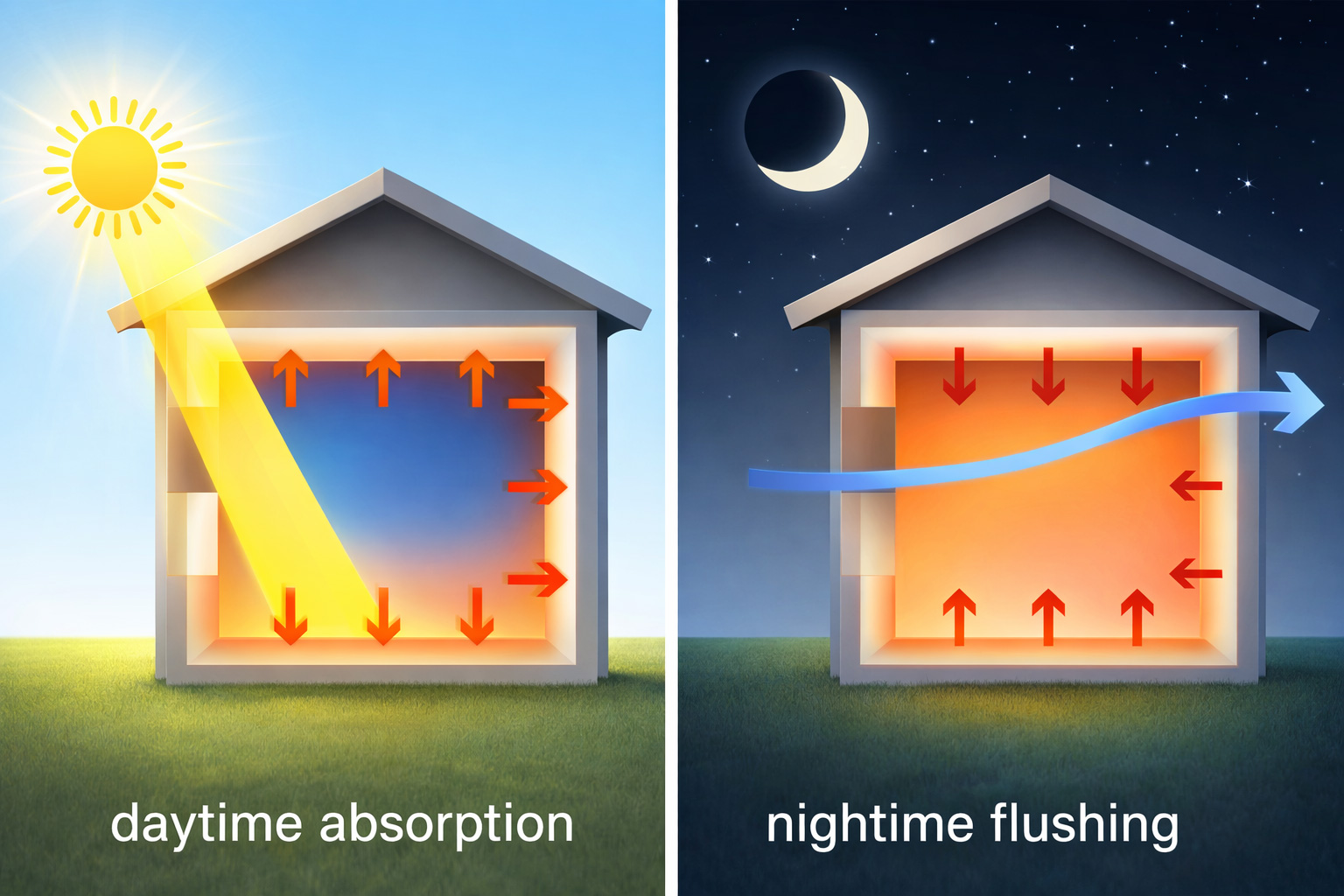
Building a log home in Ontario is not merely an aesthetic or heritage choice. When properly designed, a solid wood log home functions as a true thermal battery naturally storing, stabilizing, and redistributing heat throughout the year, even in Ontario’s demanding climate.
From Muskoka’s humid summers to Northern Ontario’s extended sub-zero winters, performance depends on recognized building science principles, rigorous envelope design, and disciplined on-site execution. This is what distinguishes a luxury log home from a purely architectural statement.
Solid Wood as a Thermal Battery: A Recognized Building Science Principle
The concept of thermal mass is well established in scientific and institutional literature. The
In practical terms:
-
Solid wood absorbs heat when interior or exterior conditions are warmer
-
It slows rapid indoor temperature fluctuations
-
It gradually releases stored heat as temperatures drop
Unlike lightweight insulation systems that primarily resist heat flow, thermal mass works across time. It moderates day/night cycles and seasonal transitions which is particularly valuable in Ontario’s climate.
12-Inch Diameter Logs Engineered for Ontario’s Climate
Our luxury log homes are constructed using 12-inch diameter logs, a structural and thermal decision aligned with Ontario conditions.
A wall of this scale offers:
-
Natural thermal continuity without cavities or internal convection
-
High thermal inertia
-
Proven multi-generational durability
That said, thickness alone guarantees just a portion of the entire system. True performance always depends on the integrity of the entire building envelope.
Airtightness: The Real Lever of Energy Performance
In cold climates, energy loss rarely occurs through solid wood walls themselves. The primary culprit is uncontrolled air leakage.
For this reason, airtightness is integrated at the design stage, in factory and rigorously executed on site.
A properly sealed envelope:
-
Retains conditioned air indoors
-
Allows the log walls’ thermal mass to perform optimally
-
Improves real comfort (stable temperatures, no drafts)
This approach aligns with guidance from the
Triple-Glazed Windows: A Strategic Complement in Ontario
Historically, windows are the weakest thermal point in any building envelope.
Integrating high-performance triple-glazed windows can allow you to:
-
Significantly reduce heat loss
-
Increase interior surface temperature for improved radiant comfort
-
Limit winter condensation
-
Improve overall building energy balance
When combined with airtight construction and massive log walls, these windows create synergy: captured heat is preserved longer and redistributed gradually.
In regions such as Northern Ontario or exposed waterfront sites, triple glazing is often a strategic upgrade as well as a luxury add-on.
Understanding Ontario Energy Code Compliance
In Ontario, energy performance is governed by the
The OBC does not rely solely on a simplistic “R-value per inch” interpretation. Compliance pathways may include:
-
Prescriptive compliance packages
-
Trade-off (performance path) modelling
-
Whole-building energy modelling
Through:
-
The thermal mass of 12-inch logs
-
Controlled airtightness
-
High-performance glazing
-
Integrated design of roof, foundation, and openings
A properly modelled and documented log home can meet Ontario’s performance-based compliance requirements.
This is a whole-building regulatory performance outcome.
A Log Home Designed as a Complete System
A truly high-performance Ontario log home is built as an integrated system:
-
Continuous massive wood walls
-
Verified airtightness
-
Climate-appropriate glazing
-
Balanced ventilation and humidity control
-
Precision construction detailing
This systemic approach delivers homes that are:
-
Comfortable year-round
-
Energy-conscious without compromise
-
Durable across generations
-
Aligned with the expectations of discerning Ontario homeowners
Conclusion: A Decision Grounded in Physics, Not Trends
A properly designed log home is not a nostalgic indulgence. It is a building science–driven structure that functions as a natural thermal battery.
The result: superior thermal stability, credible regulatory performance, and enduring comfort suited to Ontario’s climate.
For homeowners seeking architectural distinction paired with measurable performance, solid wood construction remains a refined and technically sound choice.
FAQ: Energy Performance of Log Homes in Ontario
Is a log home truly energy efficient?
Yes: when properly designed. Its thermal mass stabilizes indoor temperature and can reduce heating demand, particularly in cold climates like Ontario’s.
Is it compliant with Ontario building standards?
Yes — a log home can comply with the Ontario Building Code’s energy-efficiency requirements when it is designed to meet SB-12 using an accepted pathway (prescriptive package, performance modelling, or other permitted method) and the required Energy Efficiency Design Summary / supporting documents are provided for the permit.
Is triple glazing necessary?
It is a recommended option in colder or exposed regions. It can significantly reduce heat loss and maximize the benefits of log wall thermal mass. This should be evaluated with your builder during design.
Is a log home a durable long-term investment?
Yes. Solid wood is durable, repairable, and retains its thermal properties over time unlike certain synthetic insulation systems.